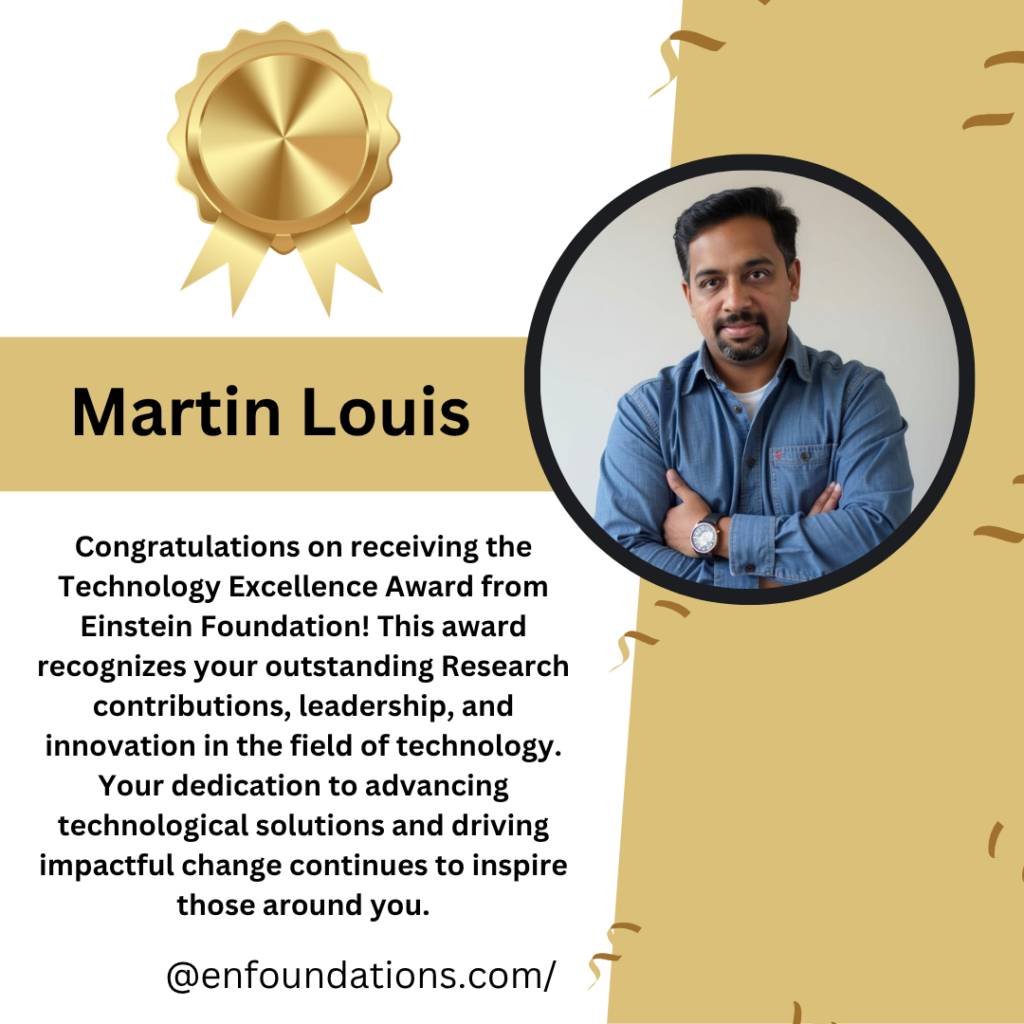
As artificial intelligence continues to transform the technology landscape, the role of enterprise technology leaders is evolving rapidly. Martin Louis, a Senior Engineering Manager and experienced technology professional, represents this evolution through more than two decades of experience spanning software engineering, enterprise platforms, artificial intelligence, cloud-native architecture, knowledge systems, and technology transformation.
Based in Austin, Texas, Martin has built a career focused on solving complex technology challenges and helping organizations develop scalable, intelligent, and reliable technology solutions. His professional journey, including more than a decade at PayPal, reflects the transition from traditional enterprise software toward increasingly intelligent and AI-enabled technology ecosystems.
From Software Engineering to AI-Driven Technology
The development of modern enterprise technology requires expertise across multiple disciplines.
Software engineering provides the foundation. Cloud platforms provide scalability. Data and knowledge systems provide context. Artificial intelligence provides new capabilities for automation, reasoning, personalization, and decision support.
Martin Louis’s professional experience intersects across these areas.
His work and areas of expertise include enterprise AI, platform engineering, cloud-native systems, semantic search, knowledge graphs, AI-enabled platforms, agentic systems, and engineering leadership.
This multidisciplinary perspective enables technology leaders to look beyond individual tools or technologies and consider how entire platforms can evolve to support the next generation of enterprise applications.
The Rise of Enterprise AI
Artificial intelligence has moved from experimental research environments into mainstream enterprise technology.
Organizations are increasingly exploring how large language models, generative AI, intelligent agents, and machine learning capabilities can improve products, workflows, knowledge discovery, and customer experiences.
However, implementing AI at enterprise scale introduces significant engineering challenges.
Organizations need reliable infrastructure, secure data access, scalable services, evaluation frameworks, governance mechanisms, and effective integration with existing systems.
Martin’s professional focus on enterprise AI and platform engineering reflects this broader challenge: building the foundations that allow AI technologies to become dependable components of real-world enterprise systems.
Platform Engineering as the Foundation for Innovation
AI innovation cannot exist independently of strong engineering infrastructure.
Modern platforms must support scalability, reliability, security, observability, and continuous development while accommodating rapidly changing technologies.
Martin Louis brings extensive experience in platform engineering and cloud-native architecture, with a focus on developing technology foundations capable of supporting enterprise-scale products and services.
Platform engineering also creates an important bridge between engineering teams and product organizations.
By establishing reusable infrastructure, services, tools, and architectural patterns, engineering organizations can accelerate innovation while maintaining consistency and reliability.
Exploring Agentic AI
One of the most significant developments in artificial intelligence is the emergence of agentic AI.
Unlike conventional software that follows explicitly defined workflows, AI agents can potentially interpret goals, reason through tasks, retrieve information, interact with tools, and execute multiple steps within a workflow.
This creates new possibilities for enterprise software.
Agentic systems could assist organizations with knowledge discovery, customer support, engineering workflows, product operations, business processes, and decision support.
But agentic AI also introduces new engineering questions around security, reliability, evaluation, permissions, observability, and human oversight.
Martin’s interest in AI-native and agentic technologies reflects the growing need to approach these systems not merely as AI experiments, but as components of robust enterprise platforms.
Connecting Enterprise Knowledge With AI
One of the biggest challenges in enterprise AI is providing intelligent systems with the right information.
Organizations possess vast amounts of knowledge across documents, databases, applications, APIs, and internal systems.
Traditional search approaches often depend heavily on exact keywords. Modern AI applications increasingly require systems that understand relationships, context, meaning, and intent.
This is where technologies such as semantic search and knowledge graphs become increasingly important.
Martin’s professional interests in these areas align with the broader movement toward intelligent knowledge systems capable of connecting enterprise information and making it more accessible to both people and AI applications.
Cloud-Native Technology and Scalable Systems
The adoption of AI also depends heavily on modern cloud infrastructure.
Cloud-native architecture enables organizations to build systems that can scale dynamically, integrate distributed services, and respond to rapidly changing workloads.
Martin’s experience across cloud services, software engineering, and enterprise platforms provides a strong foundation for understanding how cloud technologies can support modern AI-enabled applications.
The combination of cloud-native engineering and artificial intelligence is increasingly shaping how organizations build technology platforms capable of supporting intelligent products at global scale.
Engineering Leadership in a Changing Technology Landscape
Technology leadership is not only about architecture and tools.
It is also about people.
As a Senior Engineering Manager, Martin Louis brings experience in engineering leadership, mentoring, technical strategy, collaboration, and multi-team technology initiatives.
Building successful engineering organizations requires creating an environment where teams can experiment, learn, solve complex problems, and deliver reliable technology.
In the era of AI, engineering leaders also have an important responsibility to help organizations distinguish between technology hype and practical value.
The most successful AI initiatives are likely to be those that combine innovation with disciplined engineering and clear product objectives.
Responsible and Trustworthy AI
As AI becomes more powerful, responsible technology development becomes increasingly important.
Enterprise AI systems may interact with sensitive information, influence customer experiences, and participate in important business workflows.
This creates a need for thoughtful approaches to AI governance, security, transparency, reliability, evaluation, and human oversight.
Martin’s professional interests include responsible AI and trustworthy intelligent systems, reflecting the importance of building technology that organizations can adopt with confidence.
Responsible AI is not simply a policy concern. It is also an engineering challenge.
It requires technology teams to consider how systems behave, how they are evaluated, how failures are detected, and how humans can remain meaningfully involved.
A Career of Continuous Technology Evolution
Martin Louis’s career illustrates how technology professionals can evolve alongside major changes in the industry.
From software engineering and enterprise systems to cloud platforms and artificial intelligence, his professional journey demonstrates a commitment to continuous learning and technological adaptation.
His current areas of focus reflect some of the most important technology trends shaping enterprise computing today:
Artificial Intelligence · Agentic AI · Generative AI · Enterprise Platforms · Semantic Search · Knowledge Graphs · Cloud-Native Architecture · Responsible AI · Software Engineering · Technology Transformation
These disciplines are increasingly converging to create a new generation of intelligent enterprise systems.
Looking Toward the AI-Native Enterprise
The future of enterprise technology will likely not be defined by AI models alone.
It will be defined by the platforms, architectures, knowledge systems, engineering practices, and organizations built around those models.
AI-native enterprises will require technology leaders who understand both the possibilities of artificial intelligence and the engineering realities of deploying complex systems at scale.
Martin Louis’s professional work sits at this intersection.
Through enterprise technology leadership, platform engineering, AI innovation, knowledge systems, and engineering mentorship, he continues to contribute to the development of scalable and intelligent technology solutions.
His career reflects an important principle for the next generation of technology: innovation becomes transformational when it is supported by strong engineering, meaningful enterprise applications, and responsible leadership.
Martin Louis and the Future of Enterprise Technology
With more than 20 years of experience in technology and engineering, Martin Louis continues to explore how artificial intelligence and modern platform technologies can reshape enterprise systems.
His expertise across Enterprise AI, platform engineering, cloud-native architecture, intelligent systems, semantic technologies, and engineering leadership positions him within an increasingly important area of the global technology landscape.
As organizations move toward more intelligent, connected, and autonomous systems, technology leaders such as Martin are helping shape the engineering foundations required for that transition.
His continuing contribution to AI and enterprise technology reflects a commitment to innovation, engineering excellence, responsible technology, and the development of future-ready digital systems.